New to Sly Flourish? Start Here or subscribe to the newsletter. Listen to articles on Readings and Reflections.
Preorder Rise of the Lazy Gamemaster!
Scenes and Situations
by Mike on 19 October 2026
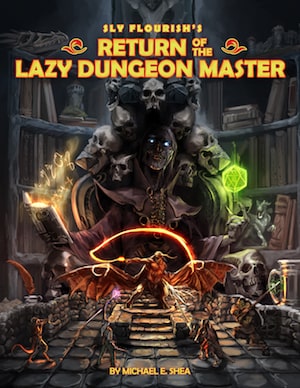
The eight steps from Return of the Lazy Dungeon Master haven't changed for me over the past eight years and I've used them hundreds of times to prep my games with several different systems. What I do in each step has changed, however. Often I expanded each step and even moved some steps around to better fit my prep, my materials, and the games I run.
One big change was moving the Strong Start into my Scenes step. The strong start is still a separate step – I just moved where I write it to my Scenes section to condense my notes and avoid either duplicating it or making the scenes outline incomplete (since the strong start is a scene but in a different spot in my notes). This change is a personal choice. Others prefer keeping the strong start separate in their notes which is totally fine.
For me, the Scenes step has expanded. Scenes can cover a lot of ground now, for me. I might include
- big scenes like "discover the remains of the Scarlet Dawn at a cenotaph of Anu Akma".
- huge "catch all" scenes like "explore the Ossuary of Mot".
- boss battles like "face Putrescent Hestor at the Gateway to Evermaw".
- future quest choices like "Quests: find the dragonslayer sword, recover your stolen gold, or rescue Sultana Casmara Azrabahir".
- journey or story forks like "travel the wilds Gravesong Lowway or the more populated Scholars' Path".
I'll even mash in some NPCs, monsters, locations, or other steps into my scenes if I think they fit. Michael, a reader of Return remarked that, for him, it's really valuable to ask two questions when coming up with a scene:
- What do the characters see when they arrive?
- What secret is going on here or what can the characters discover?
I like these two questions a lot because they're focused on the characters and the players – a big drive for the eight steps overall.
Scenes as Situations
A criticism I see of the "scenes" step is that it's a railroad. Critics assume the scenes are pre-determined and pre-defined. They're not. Each scene can be its own situation with no pre-determined outcome and maybe not even with a pre-determined entrance. Characters might get involved in a scene in several ways and there are likely several ways the scene can play out. Keeping scenes open-ended is critical to our philosophy of playing to see what happens. For me, good scenes often have
- several ways for the characters to get involved.
- a reason to get involved.
- several ways the characters can approach the situation.
- several outcomes.
Because of the wide variety of things we can jam into our scenes step, the idea of scenes as situations doesn't always perfectly apply, but it's a good model to ensure we're not just railroading the characters down a single path.
Sometimes, though, our list of scenes really is a sequential path. If the characters crawl through the Ossuary of Mot to get to the gateway to Evermaw and then face Putrescent Hestor and his fiendish undead construct assassins, we can assume there will be a fight. But we don't know how that fight might play out. It's likely the characters succeed and get through the gate but who knows, Putrescent Hestor might be convinced to give up info instead of die at their hands.
Other big scenes like "learn the secrets in Riddermound" could go lots of ways and we can set up our eight steps to support it. We know what secrets Riddermound has. We know the demon Ix convinced Dragon Lord Threx to slay his wife, Lady Gynan, believing her a traitor. We know Ix continues to torment Lord Threx in the barrow while the spirit of Lady Gynan wallows in misery. What happens as the characters uncover these secrets? Who knows! What path will they travel through the barrow and what will they learn along the way? Who knows! We just arrange the components and see how things play out.
Scenes as Flexible Bubbles
We can think of the scenes in our "scenes" step as flexible bubbles of stories and situations that might come up in our game. Scenes aren't calcified. We don't know what will happen in them. We don't know if they'll happen at all. Our games can go in lots of different ways as it plays out with our friends. The biggest intention of a scene is to help you feel like you have your hands around the next session you're going to run enough to feel comfortable running it. Outside of that goal, we can take the "scenes" step in lots of different directions just like the scenes themselves can go lots of different ways while we enjoy the journey.
More Sly Flourish Stuff
Each week I record an episode of the Lazy RPG Talk Show (also available as a podcast) in which I talk about all things in tabletop RPGs.
Last Week's Lazy RPG Talk Show Topics
Here are last week's topics with time stamped links to the YouTube video.
- No Show Next Week – Gamehole Con
- Two Minute Session Zeros
- Three Choices
- Rise of the Lazy Gamemaster to Layout
- Grotto of the Grandfather
- Into the Maelstrom Halloween Game
- Dragon Kings Crowdfunding Campaign
- One Ring on Free League Unbound
- Dark Halls for Shadowdark
- Disability Pride Dice
- WOTC Unionizes
- Why Improvise Monsters
Patreon Questions and Answers
Also on the Talk Show, I answer questions from Sly Flourish Patrons. Here are last week's questions and answers.
Talk Show Links
Here are links to the sites I referenced during the talk show.
- Two Minute Session Zeros for Single Session Adventures
- Three Choices
- Down Among the Dead for Pirate Borg
- Dragon Kings Backerkit Campaign
- One Ring Character Building on on Free League Unbound
- Dark Halls for Shadowdark by Kobold Press
- Disability Pride Dice
- Dungeons & Dragons and Studio X Join United Wizards of the Coast - CWA
- Sign For Your Support for the D&D / MTG Union
Last week I also posted a couple of YouTube videos on Two Minute Session Zeros and 2026-10-11 Lazy GM Prep.
RPG Tips
Each week I think about what I learned in my last RPG session and write them up as RPG tips. Here are this week's tips:
- Have clear goals and clear situations for investigations and mysteries.
- Clarify what decisions lead to what types of gameplay to your players. One route leads to a dungeon crawl. One route leads to a roleplay session.
- Prepare the answer to a mystery during prep. Don’t expect to improvise it during the game.
- Find ways to include action even in mysteries, and sessions focused on roleplay.
- Use around-the-table initiative during investigation and roleplay sessions to ensure players all get a chance in the spotlight.
- Prep maps and NPCs to make investigations and mysteries feel solid and grounded.
- Draw stick and block charts to show how rooms and chambers interrelate in larger exploration adventures.
Related Articles
Share this article using this link: https://slyflourish.com/scenes_and_situations.html
Subscribe to Sly Flourish
Subscribe to the weekly Sly Flourish newsletter and receive a free adventure generator PDF!
Get More from Sly Flourish
Sly Flourish's Books
- City of Arches
- Return of the Lazy Dungeon Master
- Lazy DM's Companion
- Lazy DM's Workbook
- Forge of Foes
- Fantastic Lairs
- Ruins of the Grendleroot
- Fantastic Adventures
- Fantastic Locations
Have a question or want to contact me? Check out Sly Flourish's Frequently Asked Questions.
This work is released under a Creative Commons Attribution-NonCommercial 4.0 International license. It allows reusers to distribute, remix, adapt, and build upon the material in any medium or format, for noncommercial purposes only by including the following statement in the new work:
This work includes material taken from SlyFlourish.com by Michael E. Shea available under a Creative Commons Attribution-NonCommercial 4.0 International license.
This site may use affiliate links to Amazon and DriveThruRPG. Thanks for your support!