New to Sly Flourish? Start Here or subscribe to the newsletter.
Ending Campaigns
by Mike on 8 March 2021
At some point our D&D campaigns come to an end, hopefully by a point in the story and not due to real-life events. Today we'll talk about how to run awesome endings for our D&D campaigns.
Kitchen Sink Final Battles
Often the best conclusion we can have in our D&D games is a nice big final fight. Whether it's Tiamat, Iymrith, Strahd, or Acererak; good final battles close campaigns in a strong way.
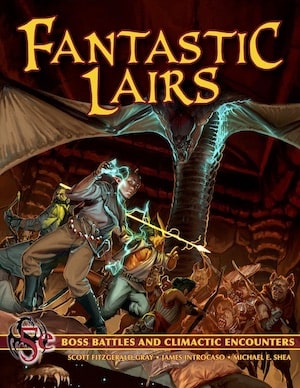
Building great final battles is hard. That's why Scott Fitzgerald Gray, James Introcaso, and I partnered up to write Fantastic Lairs which gives you twenty three big bad boss fights for your D&D games.
There are a few other things we can do to make our boss fights awesome:
Run waves of monsters. Monster waves are a great way to hit characters hard and is particularly useful when challenging high level characters. Throw waves of monsters before the boss shows up. This lets the boss show up at their own time and in their own way so the characters can't overprepare and kill them in one shot. The pace of the waves is also under your control.
Make the environment awesome. Split the battle across two sides of a portal to hell. Center it around a massive arcane gate about to explode. Set your battle on a huge crashing airship or in a room with a huge soul-eating machine hanging above a massive pool of lava. Make the environment of your final battle awesome. Give it some interesting mechanical effects that affect both characters and monsters alike.
Keep your hands on the dials. Balancing boss battles so you get perfect edge-of-the-seat excitement out of your players is hard to do. Luckily we DMs have some dials we can turn during combat to change things up. Adding waves of monsters or increasing their pace is one big dial. Adding or removing monsters is another. Increasing or decreasing hit points is a third. Adding or removing attacks or damage is another. We can tweak all of these things behind the screen, making sure that the threat keeps things exciting.
You can find more tips in our Collected Experiences Running Boss Fights.
Give Them What They Want
Fun stories surprise us with twists and turns but those twists and turns rarely serve well during the ending of a story. I wrote about this before in Breaking Endings where we looked at the ending of the TV show Breaking Bad. While the ending of that show broke many of the rules set by the rest of the show, it gave us what we wanted. A nice satisfying ending. Not all shows treat us so well.
While you might be inclined to add some crazy twists and turns to your campaign's conclusion, ask yourself if that's really what the players want. You can even ask them what they want and then give it to them. Make the ending memorable and satisfying.
One Year Later
I love time-jumps in stories. It's always awesome to fill in the blanks when time skips ahead and we don't know what happened in between.
One of my favorite tricks for ending a campaign is to ask the players where they see their characters one year after the final conclusion of the campaign. Often the stories I receive are the most interesting in the campaign. This is a way to fully hand the story over to the players. You have no new direction for the campaign at this point so you don't have to steer them at all. The characters can get married and settle down on a farm. They can become warlords in a far-away land or professors at a prestigious new arcane college. They can unite factions or start a warforged circus to soften the hardships between warforged and other humanoids.
I've asked for "one year later" stories from my players in a half-dozen campaigns now and I've never been disappointed. One-year-later stories are wonderful.
Teos Abadia takes this a step further by asking for stories 10 to 100 years later. Let the players take it as far as they want.
A Bookend to a Fantastic Tale
We want our campaign endings to be fun, memorable, and satisfying. Most often we're in danger of over-thinking it. Ask your players what they want, build in a fun climactic encounter, and ask them to talk about their characters one year after the ending. Sit back and listen to the end of a fantastic tale.
Related Articles
- Reach Satisfying Campaign Conclusions
- Collected Experiences Running D&D 5e Boss Fights
- End Sessions Before a Big Battle
Subscribe to Sly Flourish
Subscribe to the weekly Sly Flourish newsletter and receive a free adventure generator PDF!
More from Sly Flourish
Sly Flourish's Books
- City of Arches
- Return of the Lazy Dungeon Master
- Lazy DM's Companion
- Lazy DM's Workbook
- Forge of Foes
- Fantastic Lairs
- Ruins of the Grendleroot
- Fantastic Adventures
- Fantastic Locations
Share this article by copying this link: https://slyflourish.com/ending_campaigns.html
Have a question or want to contact me? Check out Sly Flourish's Frequently Asked Questions.
This work is released under a Creative Commons Attribution-NonCommercial 4.0 International license. It allows reusers to distribute, remix, adapt, and build upon the material in any medium or format, for noncommercial purposes only by including the following statement in the new work:
This work includes material taken from SlyFlourish.com by Michael E. Shea available under a Creative Commons Attribution-NonCommercial 4.0 International license.
This site uses affiliate links to Amazon and DriveThruRPG. Thanks for your support!